All Articles
USDA has awarded $40.2 million in value-added producer grants to 298 recipients in 44 states and Puerto Rico for 2012. According to USDA, the grant program is a tool for independent fruit and vegetable producers, among others in the farming industry, to enhance their ability to meet consumer demand and move their products into the marketplace. “These projects will provide financial returns and help create jobs for agricultural producers, businesses and families across the country,” said Kathleen Merrigan, USDA’s deputy secretary. “This funding will promote small business expansion and entrepreneurship opportunities by providing local businesses with access to capital, technical assistance and new markets for products and services.” Program guidelines hold that grants can be made in amounts up to $300,000 for working capital and $100,000 for planning. Applicants must be able to match the USDA grant dollar for dollar. “This isn’t just a handout,”
» Read more
As of press time, the National Leafy Greens Marketing Agreement (NLGMA) was still in limbo. The last official word was in April 2011, when USDA’s Agricultural Marketing Service (AMS) announced it was seeking public comments on the creation of a voluntary marketing agreement for the U.S. leafy greens industry. By the time the comment period closed on July 28, 2011, more than 2,000 comments had been filed, according to the AMS website. Nearly a year later, nothing has changed. Comments were still being reviewed and analyzed – and no timeline had been set for when that would end, according to AMS. So, what’s the holdup? Nobody at AMS had anything to say beyond the statements printed above, and people in the industry could only speculate. For example, the large number of public comments it received, said Karl Kolb, certification program manager for the Ohio Produce
» Read more
If you’re going to run a CSA, it helps to do it in the richest county in the country. The Community Supported Agriculture program is the “bread and butter” of Great Country Farms, said Jaclyn Jenkins, one of the farm managers. Great Country charges CSA members nearly $620 for a 20-week subscription that delivers one box of produce weekly to their homes. Two boxes delivered per week costs nearly $1,028, according to the farm’s website. The CSA program delivers about 1,500 boxes of produce per week, from June to October. The price includes free, season-long admission to the farm for the entire family, Jenkins said. Great Country Farms is in northern Virginia’s Loudoun County, the wealthiest county in the United States (thanks to its proximity to Washington, D.C.). Loudoun County has a median household income of $119,540, according to MSN Money. The Zurschmeide family had
» Read more
Onion growers typically use three types of irrigation systems: furrow, sprinkler and drip. Conversion to drip irrigation systems has been increasing for more than two decades in the Treasure Valley area, ranging from Oregon’s Malheur County to the onion-growing area of southwest Idaho. In 1989, the Oregon Department of Environmental Quality (DEQ) declared northeastern Malheur County a Groundwater Management Area (GWMA). DEQ designates GWMAs when the groundwater has elevated contaminant concentrations, resulting in part from non-point sources. That part of the county was designated the first GWMA in Oregon because of elevated nitrate concentrations in the groundwater. Clint Shock, superintendent of the Oregon State University (OSU) Malheur Experiment Station, attributed part of the nitrate contamination to furrow irrigation systems common in the area at the time. “We were leaching an awful lot of nitrogen with our furrow irrigation system,” Shock said. “So, we tried –
» Read more
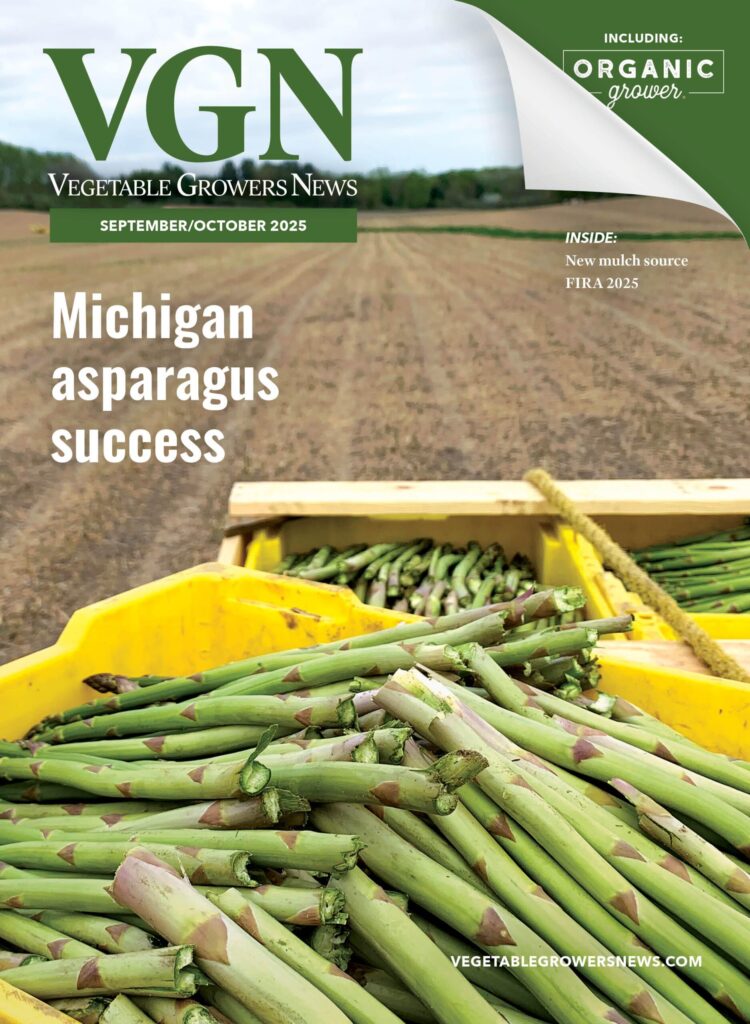
2012 was an exceptionally difficult year for asparagus growers in the Midwest and Northeast, as well as in some parts of Canada. Because of unusually warm weather in the spring, bud dormancy on the crowns was lifted in early March, causing spears to emerge much earlier than normal. For example, the first report of spear emergence in Michigan was March 19 in Benton Harbor. In Hart, Mich., most commercial fields had about 50 percent spear emergence by April 8-10 – a month earlier than the 2011 growing season. Early spear emergence has many disadvantages for the industry, including lack of labor for early harvests, premature sprouting of crowns slated for new production fields and processor facilities not being ready to receive asparagus. Furthermore, early emerging spears are at high risk for frost damage, a major cause of low yields in asparagus production. A damaging frost
» Read more
Much of labor-intensive agriculture ended 2011 scrambling to find enough human hands to complete the harvest. As this article was being written in May, we were reading numerous accounts of actual or expected farm labor shortages in both the trade and popular media, from all over the United States. A recurring question going into 2012, amid concerns that there may not be enough labor, has been, “What has changed to cause concern for shortages?” Perhaps a better question would be, “What has not changed in 2012?” Although we may be continuing on a sluggish and maddeningly unpredictable economic recovery, there is little to suggest that agriculture’s old labor competitors, the construction and maintenance industries, have recovered sufficiently to be a main cause of tight agricultural labor supplies. The continued trend toward zero net migration from Mexico may be part of the cause. Our southern borders
» Read more
I heard three strawberry breeders speak in East Lansing, Mich., this spring during a meeting of the RosBREED Project. RosBREED seeks to improve marker-assisted breeding efforts in the Rosaceae plant family (which includes strawberries). One of the tremendous benefits of RosBREED is the gathering of minds in one place, breeders and geneticists working in common and sharing information – “cross fertilization,” as Jim Hancock, a professor with Michigan State University, put it. Tom Davis, a professor of plant biology and genetics at the University of New Hampshire, said he considers himself more of a geneticist than a breeder. His role with RosBREED is to harvest information from the strawberry genome – which his lab helped to sequence – to develop tools for breeders. An exciting development has been the work on transferring wild strawberry genes to domesticated berries. Turns out, the strawberry has a huge
» Read more