

Peak nutrition in Penn





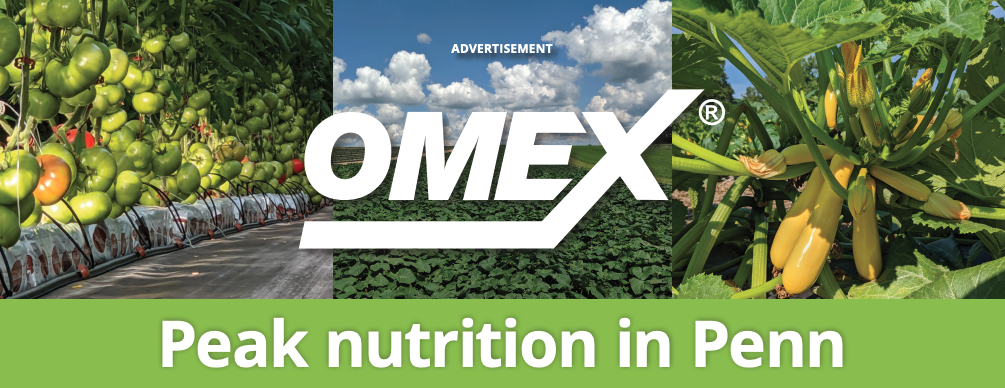
{Sponsored} — Fifth-generation farmer Kegan Wright is grateful for his investment in technology since taking over the family holding at Rochester Mills, Pennsylvania, nine years ago. It’s little trouble to pull out his phone, open the necessary app and run a quick check on the data, before adjusting the ventilation and shading in his high-tunnel greenhouse from wherever he happens to be at the time.
But right now, he’s wishing the latest addition to his ‘high-tech’ high-tunnels at Pine Valley Farms — an automatic, remote watering system, planned as a winter upgrade project — was already installed.
“Every day these last few weeks, I’m constantly running around to set the irrigation right,” he says. “During summer in these parts we usually expect temperatures to reach the low 80s, but it’s been in excess of 90 degrees for some weeks now.
“Everything’s so dry. We’ve been going on for more than a month without rain. It hasn’t been this dry for some years.”

Kegan Wright
Wright’s 300-acre farm includes more than 100 acres of mixed vegetables, field-grown as well as the protected crops within the greenhouse. Since he took charge in 2011, he’s increased the acreage and started to put his own stamp on the unit, and not only with technology. Wright’s approach to agronomy is to leave nothing to chance.
“It’s incredible to see what a plant can deliver when it’s at peak performance,” he says. “But to get it to that level demands careful, close attention. You can’t afford to second-guess nutrition; you’ve got to be able to recognize what a plant needs, when, how and why.
“Get that right and it’s easy to get your crop producing at maximum output.”
Wright’s efforts are suitably rewarded. Pine Valley Farms’ produce supplies four warehouses and multiple grocery stores. That would be enough for most producers, but Wright’s not done: he also owns three roadside markets, which he says have done a ‘phenomenal’ trade this year.
“I think COVID has encouraged shoppers to seek out local suppliers, but despite concerns about visiting grocery stores — social distancing, masks, etc. — store business is up too. That’s probably because restaurants have been shut down; people are not eating out but at home.”
Wright has an unerring focus on yield and quality that he knows can only be achieved with a solid approach to managing crop nutrition. His search for a range of nutritional products whose use and application he could tailor to his needs and his varying crop portfolio prompted him to seek a meeting with Dean Konieczka, an agronomist with California-based crop nutrition specialist OMEX®.
“Someone who’s literally growing everything from A to Z — asparagus to zucchini — needs products that are reliable, effective and, above all else, flexible in use and application,” notes Konieczka. “You don’t want to be filling your chemical store with stacks of different products for each crop.
“Not only is it expensive to keep inventory like that, but it increases labor costs and the risk that a crop could receive the wrong treatment, or even one that’s unapproved,” Konieczka points out.
“Because Kegan is so hands-on with his agronomy, he knew exactly what problems he needed to solve. We could quickly identify what products were most suited to his needs and which added the most value to his nutritional toolbox.”
Wright has been particularly impressed with Cell Power® SizeN® Ca. A stabilized amine nitrogen, it employs a unique delivery mechanism developed by Levity CropScience, OMEX®’s British technology partner.
“It’s made a huge difference to our high-tunnel tomatoes,” he says. “Previously they were grading out at 5×6 and 6×6, but the plants that received SizeN® have been turning out fruits that graded at 4×5 instead.
“We’re using it as soon as they come out of blossom, fifty-fifty between foliar and the irrigation system. There really is no comparison with what went before – the amine nitrogen delivers a massive boost to the size of the fruit. On top of that, we’ve got the calcium addition to prevent blossom end-rot.”
Wright says he’s becoming increasingly reliant on foliar applications because of rising humidity. “When the weather’s humid, the crop’s evapotranspiration starts to drop off. This reduces the water uptake through the roots and so there’s lower uptake of vital nutrients too.”
Yellow squash and zucchini have also shown a marked response to SizeN®, Wright notes, with treated crops setting up to five fruit a day (yellow squash) and between two and three a day for zucchini.
“What you have to remember,” Wright points out, “is that in increasing the availability of one nutrient you’ll often raise the performance of the plant to the point where it needs a corresponding increase in another nutrient — potassium, for example — in order to make the most of the extra opportunity it’s been given.
“But when you get everything right, it’s just amazing what a plant can deliver.”
Learn more at www.omexusa.com. The product names and brands referenced here are registered and trademarks of OMEX® Agrifluids, Inc. © OMEX® Agrifluids, Inc. 2020.