

2026 GPS datum shift: specialty crop grower checklist
Precision matters. Learn how an upcoming GPS change could affect your crop rows, beds and long-term data, and how to prepare now.





A nationwide GPS update in 2026 could shift your field coordinates by several feet, according to a pair of digital ag Extension specialists with Iowa State University.
What is happening to GPS data soon?
In 2026, the National Geodetic Survey (NGS) will officially replace two common GPS datums that Iowa State says “form the foundation of nearly every GPS coordinate used in agriculture, from RTK auto-steer lines to tile drainage surveys.”
- NAVD 88 will be replaced by NAPGD2022 (vertical positioning: elevations)
- NAD 83 (2011) will be replaced by NATRF2022 (horizontal positioning: latitude/longitude)
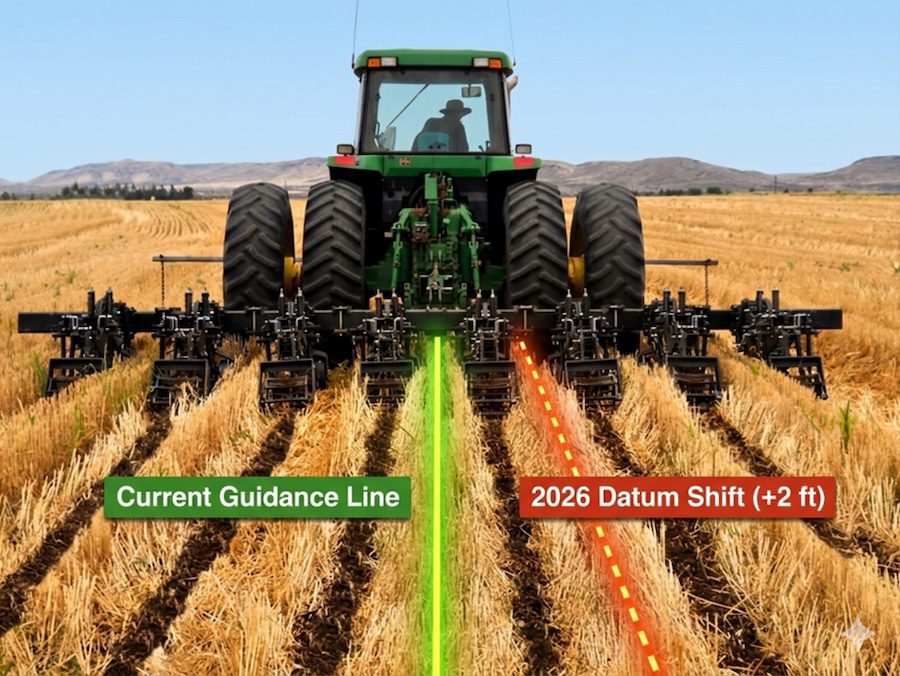
What it means: If you rely on repeatable accuracy, your field maps, crop rows and machinery guidance system lines (ie. A-B lines) may no longer line up after the datum shift.
What is a GPS datum?
A GPS datum is the reference system that tells your GPS controller exactly where “here” is on Earth. Basically, it’s the mathematical model behind every map coordinate your farm equipment uses to spatially orient itself accurately. Think of it like the baseline map your guidance system is built on.
When that baseline reference point changes (as it will in 2026 with the NGS datum shift), the same physical spot in a field can end up with slightly different coordinates that can differ up to a few feet. In farming, that matters because precision agriculture tasks like planting, spraying, variable-rate fertilizer applications, mapping fields and field boundaries, or even managing drip irrigation line placement depends on hitting the exact same location year after year. If the datum changes and your system isn’t updated, your machinery guidance lines, as-planted or as-applied maps and GPS-guided or autonomous equipment can all be slightly off, even though nothing in the field actually moved.
Grower checklist: tasks Iowa State Extension recommends before the datum shift
1. Back up everything
Save copies of:
- Field boundaries.
- Row/bed maps.
- Guidance lines.
- Irrigation layouts.
- Drainage or elevation data.
Store in at least two places (cloud + physical hard drive).
2. Talk to your equipment dealer
According to Iowa State, AgLeader, John Deere (StarFire GPS receiver) and Case IH (AFS receiver) users will not be affected by the 2026 datum shift. If you use a different brand of machinery and/or GPS signal receiver, be sure to ask your machinery dealer or sales rep:
- Will my system support the new GPS standard?
- Will I need updates or new hardware?
- What happens to my existing maps and guidance lines?
3. Know your risk level
You’re considered high risk if you use:
- RTK correction (especially your own base station)
- Permanent beds, orchards, or vineyards
- Controlled traffic, autonomous equipment or repeat-pass systems
You’re considered lower risk if you use basic GPS guidance without high-accuracy corrections.
4. Plan how you’ll handle existing data
Pick one approach:
- Re-map: re-survey rows, beds, and key features.
- Convert: update existing data using software tools.
- Quick adjust: apply a basic shift (+/- 2 ft.) to get close.
5. Protect permanent crop features
Double-check alignment for:
- Tree rows / vine rows.
- Raised beds.
- Trellis systems.
- Irrigation lines (drip, pivots).
- High tunnels / greenhouse layouts.
6. Avoid mixing old and new data
During the transition period:
- Don’t combine maps from different GPS systems without converting them to the new datum.
- Be cautious when sharing data with custom operators.
7. Test your GPS system and equipment before the season
Before planting or field work:
- Verify guidance lines match actual rows.
- Check offsets in a known area.
- Fix problems before they affect critical field operations like planting, spot-spraying, or making variable rate fertilizer applications.