

H-2A employers: Review new AEWR wage requirements
Most employers must comply beginning Aug. 3 while employers in certain states covered by a federal court order have until Aug. 17.





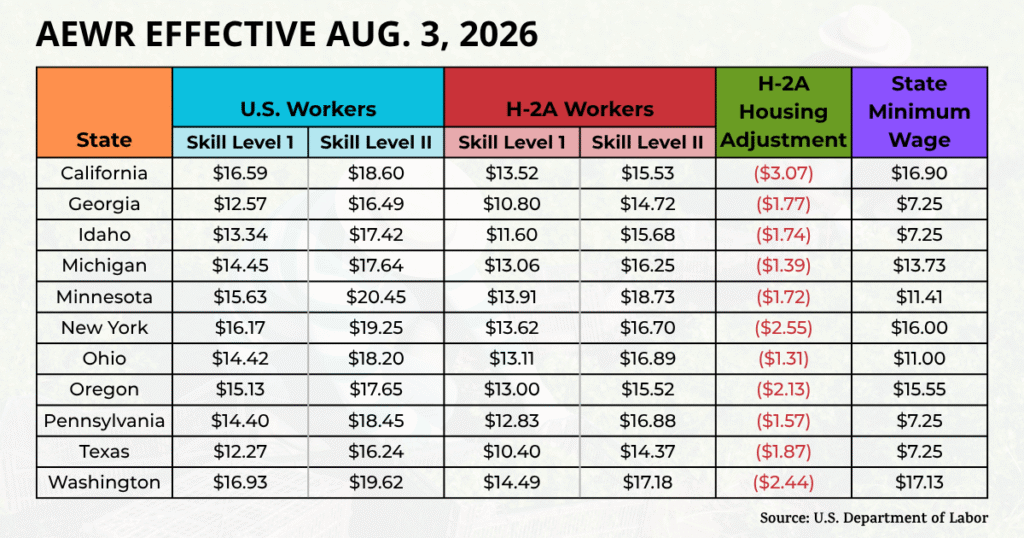
The U.S. Department of Labor (DOL) has released its 2026-2027 Adverse Effect Wage Rates (AEWRs) for H-2A agricultural workers employed in non-range occupations.
The updated tables provide farm employer guidance on the minimum wage rates employers must offer, advertise and pay to H-2A workers and domestic workers.
DOL: What H-2A employers should do now
Employers with current or pending H-2A applications should:
- Review the updated AEWR applicable to each certified job opportunity.
- Update job orders, recruitment materials and payroll systems where necessary.
- Confirm that workers are paid at least the highest applicable wage, including the AEWR, prevailing wage, collective bargaining wage (if applicable), or federal, state, or local minimum wage.
- H-2A Labor Contractors should also note that the updated national average AEWR will be used to calculate required surety bond amounts.
The rates are based on the DOL’s methodology and, according to the agency, are intended to ensure the employment of H-2A workers does not “adversely affect” the wages and working conditions of American farm workers. State-specific hourly AEWRs vary based on occupation and location.
According to the Department, the new rates are effective Aug. 3, 2026. However, in some states implementation of the new rates is delayed until Aug. 17 for employers covered by a federal court order in Kansas et al. v. U.S. Department of Labor. The states signed onto that legal action include: Arkansas, Florida, Georgia, Idaho, Indiana, Iowa, Kansas, Louisiana, Missouri, Montana, Nebraska, North Dakota, Oklahoma, South Carolina, Tennessee, Texas and Virginia.
The complete list of state-specific Adverse Effect Wage Rates for non-range occupations is available on the Department of Labor’s Foreign Labor Application Gateway (FLAG) website.