

Vegetable surfaces contribute to foodborne illness





Foodborne illness outbreaks do more than make us sick. Not only can the U.S. economy suffer as a result of reduced worker productivity, particular sectors of the farming industry can experience negative consumer perception, potentially leading to sustained profit losses. In an effort to understand and eventually reduce the incidence of foodborne illnesses, University of Illinois (U of I) researchers studied the ability of pathogenic viruses to adhere to fresh produce surfaces.
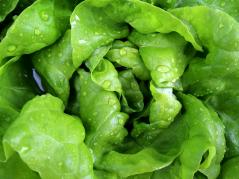
Salad vegetables can be vectors of foodborne pathogens, including viruses and bacteria. Photo: ACES/University of Illinois
“We chose 24 of the most common salad vegetables in the U.S. and assayed them to see if there was any relationship between the morphology and chemistry of the leaf or fruit surface and the adherence of viral particles, before and after a washing treatment,” said U of I Geneticist Jack Juvik.
The researchers inoculated leafy salad greens and tomatoes with a swine virus that mimics human rotavirus, a common pathogen responsible for diarrhea, vomiting, fever, and abdominal pain. After exposing the vegetable surfaces to the virus, the researchers rinsed the vegetables twice with a standard saline solution.
“We correlated virus adherence to roughness of the surface at different scales. We also looked at the chemistry of the proteins and waxes associated with the leaf cuticle – a waxy layer that protects the plant against diseases and reduces water loss,” Juvik explains. “Before this, no one had tested the relationship between chemistry and surface texture on the adherence of virus particles.”
The researchers found a thousand-fold difference in the number of viral particles adhering to different types of leafy greens and tomatoes. Vegetables with three-dimensional crystalline wax structures on the leaf cuticle harbored significantly fewer virus particles after rinsing. This was counterintuitive, as it was expected that small virus particles could “hide” in the rough structures of these cuticles.
“I was surprised, too,” Juvik says. “But normally, viruses adhere to oxygen groups, like OH, which are associated with proteins and carbohydrates on the surface. When the wax completely covers the surface, it becomes totally hydrophobic, which renders the whole leaf surface harder for viruses to attach to. Furthermore, rinsing those leaves with water gives the viruses the OH groups they’re looking for, so they’re easier to wash away.”
Produce is exposed to viruses and other pathogens in a number of ways, including contaminated irrigation water, animal wastes, and handling by sick workers. But because salad vegetables are consumed fresh, pathogens cannot be killed by cooking or most other sterilization methods.
“Viruses are literally everywhere, causing many opportunities for infection. But the information from this study can be used down the road to select or breed for varieties that might have the capacity to reduce adherence of these particles,” Juvik explains.
The researchers have already repeated the study using the bacterium E. coli, but they plan to look at even more vegetable varieties and pathogens in future studies.
The article, “Influence of epicuticular physiochemical properties on porcine rotavirus adsorption to 24 leafy green vegetables and tomatoes” was published in PLOS One. The study was led by Lu Lu, whose co-authors included Juvik, Kang-Mo Ku, Sindy Paola Palma-Salgado, Andrew Page Storm, Hao Feng, and Thanh Nguyen, all from the University of Illinois. The project received funding from the USDA’s National Institute of Food and Agriculture.
— Lauren Quinn, College of Agricultural, Consumer and Environmental Sciences
Source: University of Illinois