

Nexgen developing virus-resistant seed lines





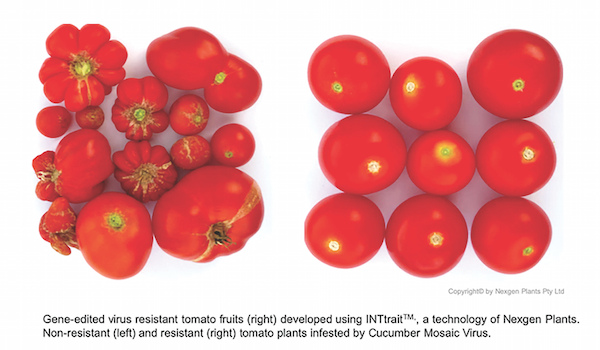
Nexgen Plants, which is based in Australia, in early July received a letter from the USDA’s Animal and Plant Health Inspection Service (APHIS) indicating its tomato lines – engineered for virus resistance – were not “plant pests” and therefore its plants and seeds could be brought to the U.S., pending an import permit. The APHIS assessment is consistent with an earlier decision it made not to regulate a salt-tolerant rice variety developed by Nexgen Plants using the same technology.
The APHIS decision is different from being cleared for use for food by the Food and Drug Administration, but still a vital first step in getting the plants closer to growers. Nexgen said its tomato lines are resistant to cucumber mosaic virus as well as tomato spotted wilt virus.
“Viruses are problematic and can become even more challenging to control if growers reduce the use of insecticides,” Nexgen CEO Philippe Herve wrote in an email. “That is why a built-in resistance in the seeds is an attractive solution – it can help growers reduce pesticide use and meet some consumers’ expectations.”
“We focused on plant health solutions and virus resistance was chosen in light of the increasing risks of virus threats across geographies,” Herve said. “The objective was to bring to growers seeds with a genetic make-up enhancing virus resistance defense based on small interfering RNAs that plants do naturally produce. To achieve this, we identified native plant DNA from the tomato genome to trigger the defense response against some virus strains. Technically, this does require the assembly of native plant DNA like putting together small building blocks and the reinsertion of this native DNA into the plant. Greenhouse results validated the technology.”
The project has yet to be commercialized. Herve said Nexgen as a research firm looks for partners to develop and commercialize seeds.
Old genetics, new research

Zhangjun Fei and James Giovannoni
The Cornell University-based Boyce Thompson Institute (BTI) in May said in a press release that its researchers, with colleagues from partnering institutions, had captured “genetic information of 725 cultivated and closely-related wild tomatoes, establishing a resource that promises to help breeders develop more flavorful and sustainable varieties.”
“The pan-genome essentially provides a reservoir of additional genes not present in the reference genome,” BTI faculty member Zhangjun Fei said. “Breeders can explore the pan-genome for genes of interest, and potentially select for them as they do further breeding to improve their tomatoes.” Other state universities, such as the University of Massachusetts Amherst, are also starting research projects looking into beneficial traits in wild tomatoes.
Herve didn’t comment on specific research projects, but said tomato genome information did help Nexgen’s own research.
“To obtain our results we needed tomato genome information because we searched native plant DNA sequences to confer the virus resistance trait,” he said. “Over time, a plant can naturally evolve at the genetic level to build its own defense against pathogens. But time is often what growers do not have to face a challenge. Genome information helped us to accelerate things and obtain the precise genetic make-up.”
Public concern over genetic engineering in food plants may persist, but Herve hopes they’ve addressed those concerns by using material already in the tomato genome.
“We all know some concerns raised by the public about inserting foreign DNA into plants,” he said. “There are scientific facts and the perceptions. Perception is very personal and, as a company, it is important that we respect the diversity of opinions and look for answers and new solutions. It is also a responsibility towards growers to bring the right products. That is why our technology uses native plant DNA to breed new traits into the plants.”
— Stephen Kloosterman, associate editor