

Colored bell pepper research highlights potential for high tunnel vegetable growing in New Hampshire
UNH trials show colored bell peppers thrive in high tunnel vegetable growing, offering farmers profitable crop options in New England.





The study was conducted in 2015 at the Woodman Horticultural Research Farm. Results showed many colored bell pepper varieties produced excellent, high-quality fruit in an unheated high tunnel.
Testing peppers as an alternative crop
Becky Sideman, researcher with the New Hampshire Agricultural Experiment Station and Extension professor of sustainable horticulture production at UNH, led the trial with graduate student Kaitlyn Orde and undergraduate student Talia Levy. They evaluated 10 colored bell pepper varieties to determine which performed best in New Hampshire’s climate.“The reason that I started this work is that growers are often looking for alternative crops for high tunnel production,” Sideman said. “Having seen a lot of unheated greenhouse production of peppers in Europe, I wanted to figure out whether greenhouse peppers could make economic sense for us in New England. I think that the jury is still out on this. We are currently repeating the experiment again, and the peppers will go into the tunnel before mid-May this year, making for an earlier — and hopefully longer — growing season.”
Sideman emphasized the potential: “Growing peppers in unheated tunnels permits the production of very high-quality colored fruit. Colored bell peppers have the potential to be a profitable, alternative crop for New Hampshire farmers, although a number of factors such as infrastructure cost, marketable yield and market prices need to be considered.”
Yield performance across varieties
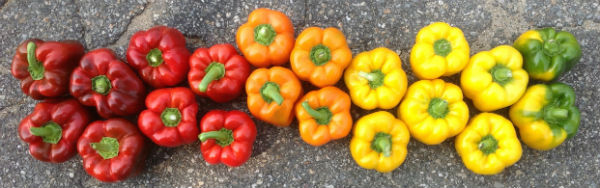
Researchers measured total and marketable yields from varieties including Bentley, Felicitas, Orangela, Sympathy, Early Sunsation, Moonset, Karma, Sprinter, Karisma and Orange Blaze. Yields ranged from 3.5 to 5 pounds of fruit per plant, equating to 46,000 – 66,600 pounds per acre. These results more than doubled typical field pepper yields of 23,000 – 27,000 pounds per acre.Bentley, Felicitas, and Orangela — classified as “High-Tech Greenhouse Peppers” by Johnny’s Select Seeds — produced the highest yields. Orange Blaze, a smaller-fruited type, produced significantly lower yields than Bentley and Felicita. However, Sideman noted no other significant differences among the varieties.
Photos: University of New Hampshire
Researchers observed a direct relationship between fruit size and number of fruits per plant. Orange Blaze, averaging 4.1 ounces per fruit, produced the most fruits per plant, while Karisma, averaging 11.2 ounces, produced the fewest. Both are classified as field peppers by Harris Seeds. Across all varieties, the percentage of unmarketable fruit remained low.
Managing defects and pests in tunnels
The most common fruit defect was sunscald, which Sideman noted “can be difficult to distinguish from blossom end rot in pepper.” Alternaria fruit rot, caused by the fungus Alternaria alternata, was also observed.Sideman stressed the important of attentive management in high tunnel vegetable growing. “Successful pepper production in tunnels requires attention to various pests, and it may be possible to increase yields by earlier planting, alternative spacing and pruning systems, or other means.”
Aphids appeared shortly after transplanting, but natural colonization of lady beetles and one lacewing release in early June controlled populations. Research also applied Bt (Dipel DF) to control hornworm larvae in August.
Production practices in the trial
Researchers planted pepper in a 30-foot by 60-foot high tunnel. Plants were seeded March 30, transplanted into 50-cells on April 15, potted into 606s on May 13, and transplanted into the tunnel on May 28. Fertility management included soybean meal, ProGro, potassium sulfate, and sidedress applications of Nature Safe 13-0-0. During transplant production, researchers used 15-5-15 Cal-Mg twice per week. In the high tunnel, drip irrigation events were triggered by tensiometer readings.
Researchers grew the colored bell peppers in an unheated high tunnel at the experiment station’s Woodman Horticultural Research Farm.
Plants were spaced 12 inches apart in single rows on 5-foot centers. Each plot contained six plants, trellised using the Almeria system, with twine applied as plants grew. Sideman said, “All fruits that set at the first and second nodes were removed from each plant, to encourage more vigorous plant growth. From then on, four leaders were maintained for each plant. All other lateral branches were removed, leaving a single fruit and flag leaf for each. Plants were pruned weekly throughout the summer.”
Harvests began August 14 and continued until October 21, when frost killed plant growing points. Sideman noted that field-grown peppers in Durham typically reach harvest by August 1. But production was delayed because peppers were transplanted later than possible and early fruits were removed to encourage growth.”
Profitability and future considerations
Fruit quality from all varieties was “excellent,” according to Sideman. She emphasized that seed costs varied widely, from $0.11 to $1.04 per seed, depending on the variety.“The profitability of this crop as an alternative enterprise will depend on actual yields in your system and whether your market(s) will pay premium prices for very high quality colored bells,” she said.
Sideman added that more experimentation is required. “It may be possible to increase yields by earlier planting, alternative spacing and pruning systems, or other means.”
She also stressed that further work is needed to assess whether adjustments in planting dates and pruning systems could increase earliness and overall yields in high tunnel vegetable growing.
— Gary Pullano, associate editor