

Warming winters increase potato production challenges and solutions
Michigan growers face potato production challenges. Read about potential solutions as warming winters fuel volunteer potatoes pest issues.





Volunteer potatoes emerge as weeds
Volunteer potatoes emerge in spring and compete with corn, soybean, and other rotational crops. In the past, cold winters froze leftover tubers, keeping them from sprouting. With warming winters, these unwanted potato plants now re-emerge almost every year.Leftover tubers produce new daughter tubers and can emerge for years after the initial planting. This re-emergence competes with other field crops for resources, contaminates rotations, and serves as a reservoir for potato pests and pathogens.
Soil temperature drives survival risk
A 25-year analysis of soil temperature shows that the risk of volunteer potato growth is high in most areas of Michigan. Survival depends on tuber depth and the number “frost hours,” defined as hours when soil temperature drops below 27° F between November 1 and March 31.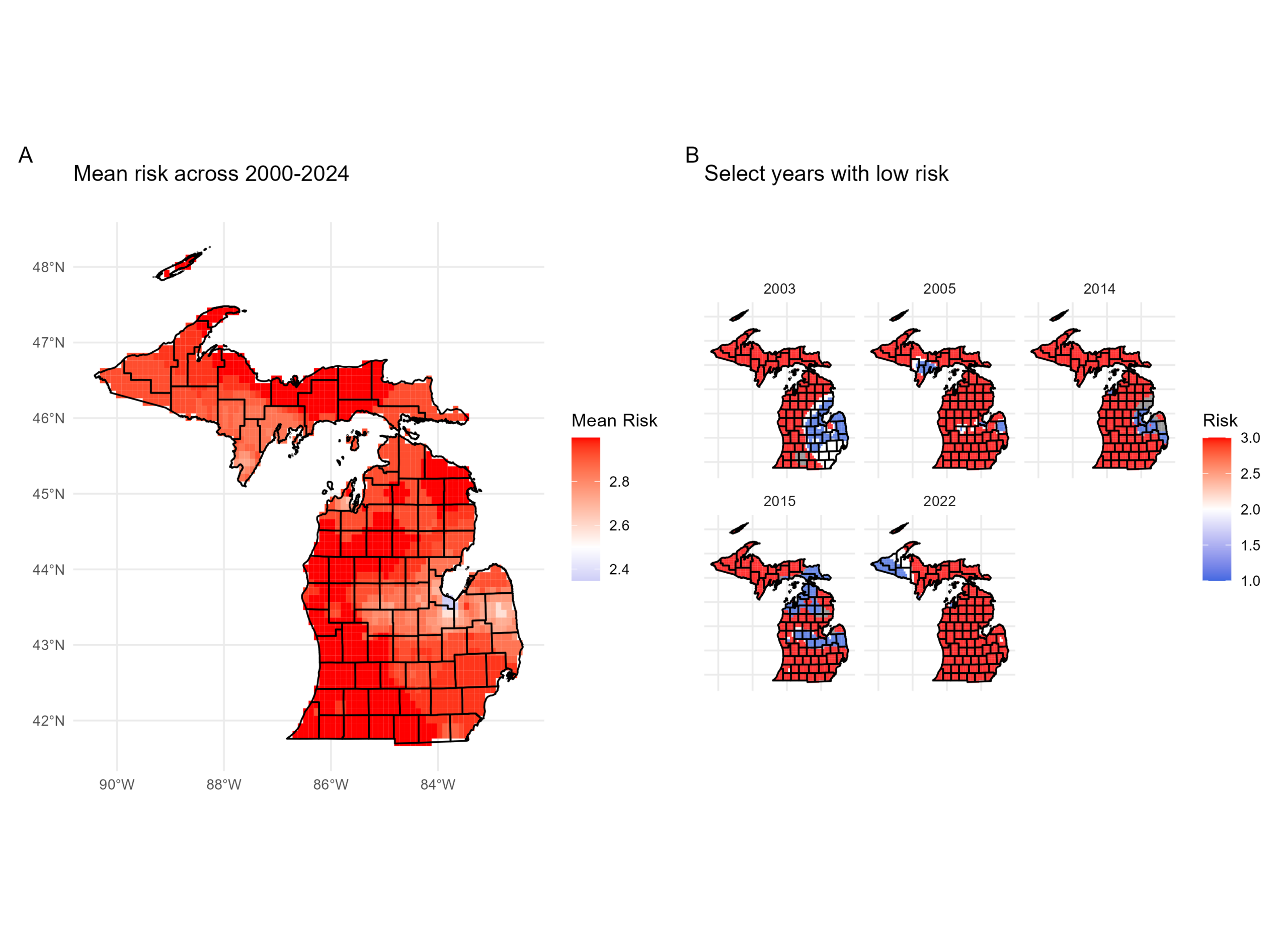
A low risk (1) of potatoes surviving the winter is defined as >120 frost hours at both 2- and 4 inch depth and a high risk (3) for having potato volunteers is <120 frost hours at both 2 and 4 inches. “Frost hours” are the number of hours when soil temperature is under 27° F between Nove. 1 and March 31. Red color on the map indicates high risk of having potato volunteers survive the winter and blue a low risk.
Researchers classify low risk as more than 120 frost hours at both 2- and 4-inch depths, and high risk as fewer than 120 frost hours. Tubers deeper than 4 inches rarely experience enough cold to kill them.
Michigan State University researchers modeled risk using soil temperatures as both depths. Over the last 25 years, many winters allowed volunteer potatoes to survive across the state. Only 2014 – 2015 showed consecutive low-risk years. High survival risk remained consistent in major potato-growing counties such as Montcalm and St. Joseph.
Regional variation in volunteer potato risk
Some areas, such as the Thumb, northern lower peninsula, and parts of the Upper Peninsula, occasionally experienced lower risk. However, Southern Michigan showed uniformly high risk. Overall, areas new Saginaw Bay and the southwestern Upper Peninsula faced slightly lower risk, while most potato production regions stayed vulnerable.Limited control options challenge growers
Chemical controls exist but often fail to eliminate volunteer potatoes. Even if herbicides kill the above-ground plant, the parent tuber can sprout new growth. Volunteers also emerge late in the season, making sprays risky for nearby crops.Volunteer potatoes interfere with corn, winter wheat, soybean, dry beans, alfalfa, and sugar beet rotations. They also serve as hosts for insects and diseases that threaten future potato crops.
Need for potato production solutions
Researcher emphasize that waiting for deep freezes to eliminate volunteers is no longer realistic. Abigail Cohen, research associate at Michigan State University, and Zsofia Szendrei, MSU vegetable entomologist, argue that Michigan growers need more research-based strategies.They stress that potato production challenges and solutions must include herbicide trials, integrated management, and adaptations to warming winters. Without better tools, volunteer potatoes will continue to act as weeds and harbor pests, and complicate potato production in Michigan.
Written by Abigail Cohen and Zsofia Pszendrei
Abigail Cohen is a Research Associate in the Department of Entomology at MSU. She focuses on analyzing and forecasting patterns in potato pests.Zsofia Szendrei is the Vegetable Entomologist at MSU.