

Research breakthrough? Liquid clay boosts romaine lettuce yields in California field trials
Following the romaine trials, the company is expanding testing to a commercial onion field and conducting additional specialty crop evaluations.





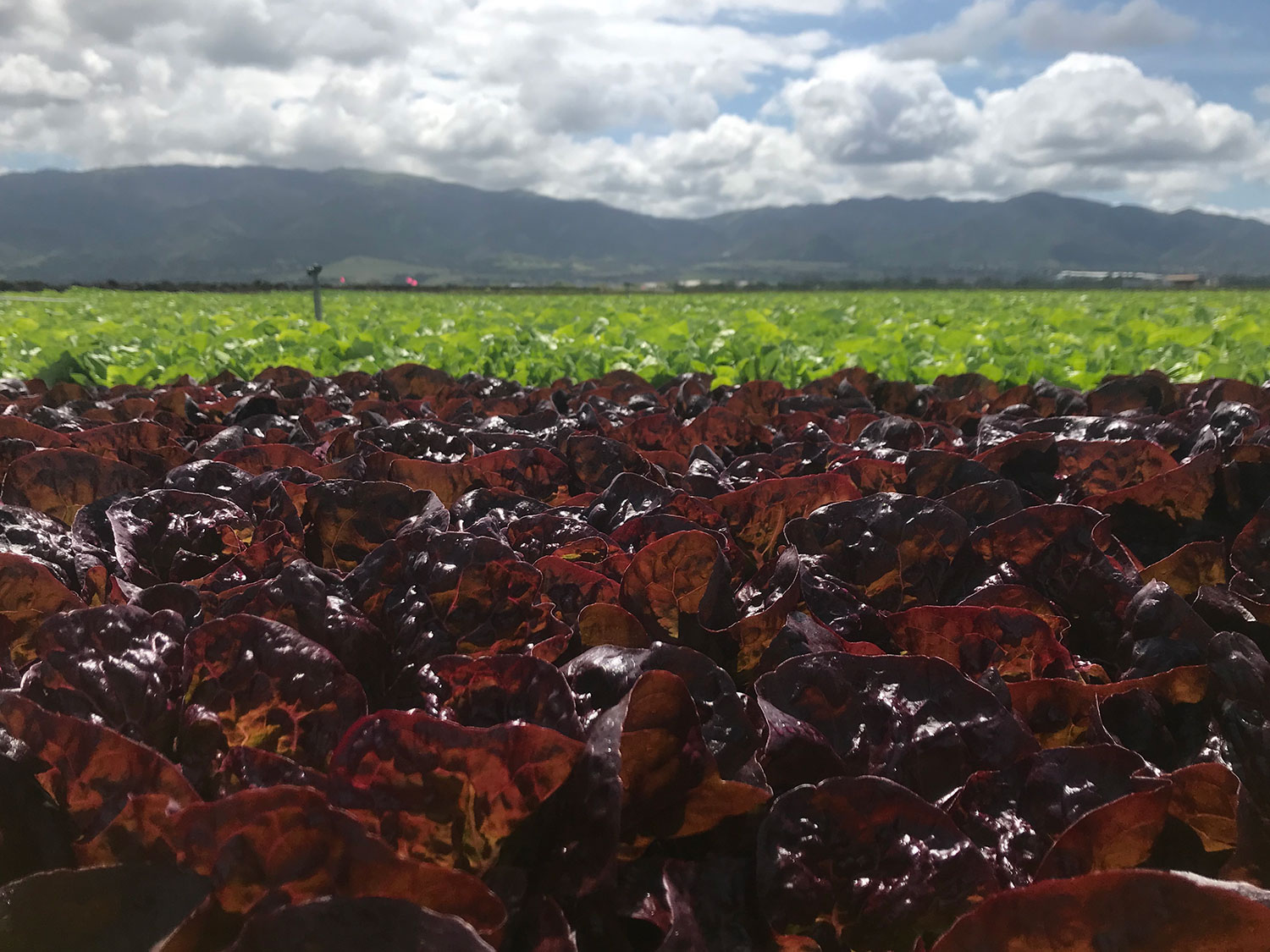
Field trials in California’s Salinas Valley suggest a liquid clay soil amendment may help improve romaine lettuce yields on sandy soils, although additional research will be needed to determine how the treatment performs across different crops, soil types and growing conditions.
According to Desert Control, two commercial-scale comparisons were conducted with a Salinas Valley specialty crop grower on historically underperforming sandy loam fields containing about 64% sand.
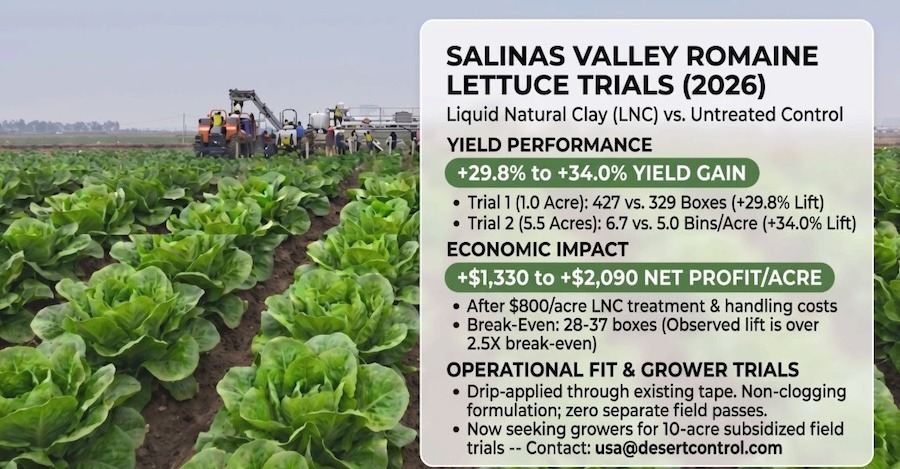
In the first trial, one acre treated with the company’s Liquid Natural Clay (LNC) was compared with an untreated one-acre block under the same irrigation practices. At harvest, the treated field produced 427 boxes of romaine hearts compared with 329 boxes from the untreated field, representing a 29.8% increase in harvested boxes. Average carton weights were nearly identical between treatments, indicating the increase came from a greater number of marketable heads rather than larger individual plants.
A second, larger comparison evaluated 5.5 treated acres against 5.3 untreated acres. According to the company, treated fields averaged 6.7 bins per acre compared with 5.0 bins per acre for the untreated acreage. Total harvested weight averaged 33,705 pounds per acre on treated fields versus 26,680 pounds per acre on untreated fields, a 21.7% increase.
Desert Control said the liquid clay was injected through the grower’s existing drip irrigation system without requiring modifications to irrigation equipment or management practices. The company said the product is designed to move through standard drip irrigation systems without clogging emitters.
The company also modeled potential economic returns based on the first trial, estimating additional gross revenue of $2,450 to $3,136 per acre at romaine prices of $25 to $32 per box. Those estimates assume an application cost of $800 per acre and are based on the observed yield increase. Actual returns will vary depending on market prices, production costs and field performance.
The technology is designed to improve the ability of coarse-textured soils to retain water and nutrients in the crop root zone. Desert Control cited University of Arizona research indicating treated soils retained moisture longer and maintained more nitrate within the active root zone than untreated soils during a 2025 commercial field evaluation.
The company noted that the Salinas Valley comparisons reflect results from one grower’s commercial production system and should not be interpreted as representative of all operations. Desert Control said additional replicated evaluations are needed to better understand performance across crops, seasons, soil types and management practices.
Following the romaine trials, the company said it has expanded testing to a commercial onion field and is conducting additional specialty crop evaluations.