

University of Florida researchers leverage AI to reduce herbicide use
University of Florida researchers are using AI to reduce herbicide sprayed on crops. Learn more about their findings and “AI smart sprayer.”





As vegetable growers use herbicides to kill weeds to prevent crop loss, a University of Florida researcher is using artificial intelligence to reduce herbicide sprayed on crops.
“We are building multiple AI-powered herbicide application units, each of which works in different ways,” said Nathan Boyd, a UF/IFAS weed scientist and horticultural sciences professor at the Gulf Coast Research and Education Center (GCREC).
Targeted herbicide applications typically kill weeds by applying the chemicals only where the weeds grow.
However, in a new study, Boyd and his colleagues developed and evaluated a precision-spraying system designed to make sure herbicide goes through the holes that scientists punch in the plastic mulch and into the soil where tomatoes are growing.
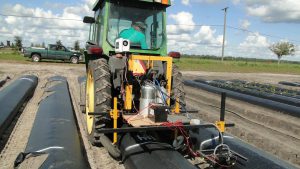
Precision weed sprayer. Photo courtesy of Nathan Boyd.
Using what Boyd calls an “AI smart sprayer,” researchers at the GCREC showed that the new technology found the punch holes 86% of the time, which translates to a savings of more than 90% on herbicide use in tomato fields at the research center.
“This equipment applies herbicide on the soil wherever there is a hole in the plastic, because that is the only place that weeds can emerge rather than over the entire bed top,” Boyd said.
Most farmers use plastic mulch to grow their vegetables. Plastic mulch is a sheet of plastic film that covers the soil in which crops grow.
In crops grown with plastic mulch, growers traditionally apply herbicides to the top of the entire soil bed just before the plastic is installed. But applying such chemicals over an entire bed is inefficient. Non-targeted applications increase production costs, the risk of crop damage and the amount of unnecessary pesticide in the soil.
Weeds compete with crops for essential resources such as water, nutrients, light and space. To control them, farmers use herbicides on about 90% of vegetable production in the United States.
That’s why it’s important to use herbicides properly.
“We are only applying herbicides into holes in the plastic mulch, which means far less herbicide use. This is pretty dramatic,” Boyd said. “The purpose of our technology is to develop a way to apply herbicide only where weeds can emerge — in the planting hole — rather than the entire bed top.”
For several years, Boyd and his colleagues have been using AI to try to control weeds with pre- and post-emergence herbicides.
In 2018, Boyd and Arnold Schumann, a professor of soil, water, and ecosystem sciences at the UF/IFAS Citrus Research and Education Center, developed a precision sprayer that sends herbicide through the holes in plastic mulch.
But their machinery did not incorporate an AI algorithm for punch-hole recognition, which would make the herbicide spraying more precise, Boyd said. Now, the technology can find the punched holes with better precision.
Researchers must now get the technology onto farms so growers can use it, and there are next steps.
“Further research is needed to assess the economic implications of herbicide reductions and evaluate the cost-effectiveness of the technology,” Boyd said.
— Brad Buck is a senior public relations specialist for UF/IFAS communications