

UF experts deploy AI to help farmers forecast tomato yields
New UF-developed tools use artificial intelligence to count fruit and flowers, helping growers forecast strawberry and tomato yields more accurately.





If there’s ever been a year when accurate crop yield estimates prove useful, this year would likely be it: a long, brutally cold winter and unexpected late-spring freezes in multiple regions around the country left many specialty crop growers short on early-season harvests.
Florida growers also felt the sting of frost this season, with the state’s commissioner of agriculture, Wilton Simpson, calling the freeze “one of the most damaging freeze events in Florida agriculture’s history, with preliminary estimates totaling over $3 billion in agricultural losses.”
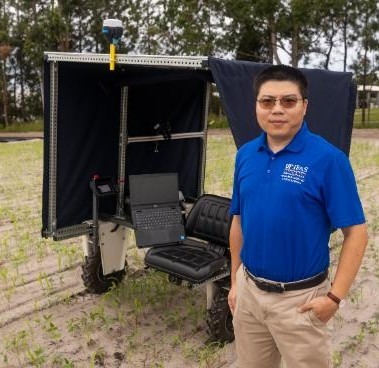
Researchers like Kevin Wang (shown right) at the state’s premier Land-Grant institution, the University of Florida, are in the process of developing web-based tools that incorporate artificial intelligence to help producers with yield predictions.
According to a press release from the UF Institute of Food and Agricultural Sciences (IFAS), such forecasts are critical.
In Florida, the production value for strawberries was $714 million and $532 million for tomatoes in 2025, according to the USDA-NASS. The goal of the web tools is to give growers fast, accurate estimation and prediction of yields, rather than making economic projections based on manually counting the crops or historic data that can vary greatly.
Wang, an assistant professor of agricultural and biological engineering at UF/IFAS, recently gave strawberry growers an update on the two-step applications, known as PhenoSeg and PhenoSnap.
According to the university:
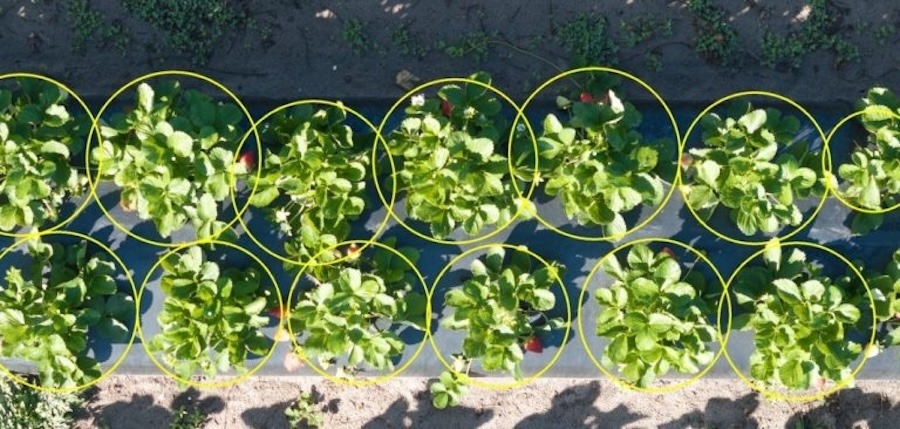
- PhenoSeg focuses on segmenting individual plants via drone imagery – essentially isolating each plant from the background so scientists and growers can count plant-level fruit and flowers more precisely.
- PhenoSnap is the UF web-based application that detects and counts fruit, flowers and runners on strawberries. It can also count tomato fruit and flowers.
Both applications are hosted on UF’s HiPerGator, a university-owned supercomputer. Because they’re on HiPerGator, researchers and growers don’t need to install any software or have powerful computers, Wang said. They can get the results by uploading images through a web browser.
Head here to read the full story over at UF/IFAS.