

Before laying plastic, check the soil pH





Mid-April is when plastic mulch laying starts for many of our summer crops. Each year we see problems with low bed pH under plastic mulch. This can result in a range of problems including poor growth, manganese toxicities, calcium and magnesium deficiencies, poor fruit quality, increased water stress, and increased blossom end rot.
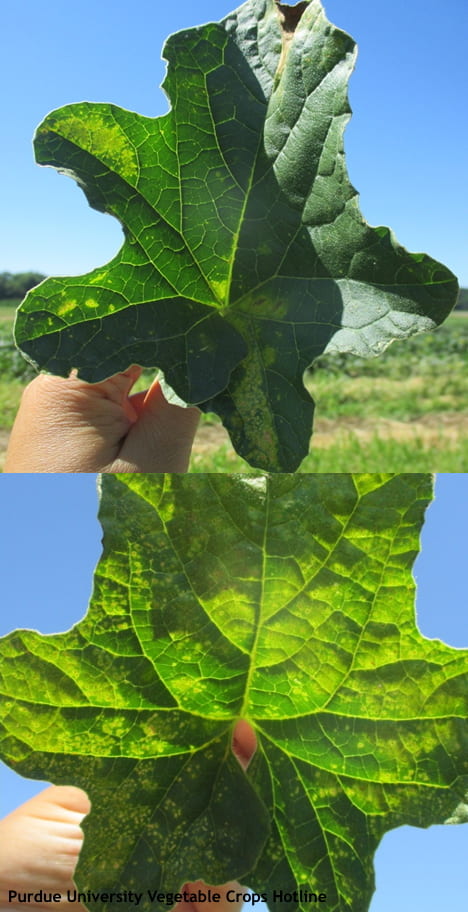
Manganese toxicity in cantaloupes due to low soil pH. Cantaloupes are particularly sensitive to manganese when bed pH drops below 5.8.
If whole field pHs are below 5.8 there is a high likelihood that areas in the field have a pH of 5.2 or below. If fields are in the third year from a lime application, the risk of low pH areas in the field also increases.
At pHs below 5.2, there is an increase in exchangeable aluminum (Al3+) which is toxic to plant roots. This free aluminum will cause roots to stop growing. Roots will be short, thickened, and stubby and will be brown in color and there will be few fine roots. Poor root growth will lead to increased plant stress, reduced nutrient uptake, reduced water uptake, and poor aboveground growth. In addition, exchangeable aluminum competes with cation nutrients such as calcium (Ca2+) and magnesium (Mg2+) on soil exchange sites. Excess aluminum reduces phosphorus and sulfur availability by complexing with those nutrients, rendering them unavailable for plants.
Another issue at low pH is that certain minerals become more available and may increase to toxic levels. This is what happens with manganese in some low pH soils. Sensitive crops such as muskmelons can be injured when available manganese increases to toxic levels.
Another issue is with the use of nitrogen fertilizers with ammonium or urea which are acid forming. Ammonium is found in ammonium sulfate, ammonium nitrate, mono and di-ammonium phosphate, and urea ammonium nitrate solutions. Urea is found in UAN and as straight urea. Urea has the short-term effect of increasing pH, but once ammonium is released in the soil from the reaction of the urea, the long-term effect will be to reduce pH.
All manures and organic nitrogen sources release ammonium upon mineralization. Depending on the organic source, the pH may decrease. Poultry manures tend to maintain pH as do many composts, but other organic nitrogen sources will often lower the pH.
In plasticulture beds, the use of these acid forming fertilizers or soil amendments during bed formation or with fertigation through the drip tape will lower soil pH: if the bed pH is marginal to begin with (5.3-5.6) it can be lowered over the season to below the critical pH of 5.2 and cause problems with the growing crop.
Once plastic is laid, there are few solutions to correct the pH of the soil. The key is to apply needed lime before the mulch is applied.
– Gordon Johnson, Extension Vegetable & Fruit Specialist, University of Delaware