

Muckland onion growers receive NY state award for pest management





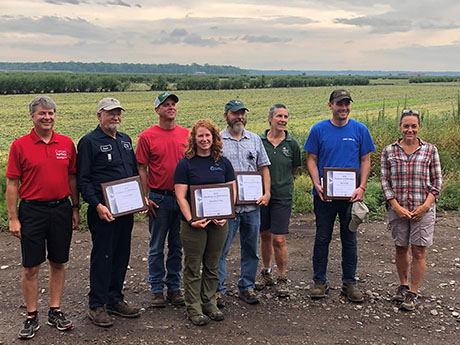
Onions grown in muck soil – organically rich former swampland where production practices are unique and intense — are one of the most valuable crops in New York, with an average value of $34.6 million. In the Elba muck and surrounding pockets in Orleans, Genesee, and Livingston counties, eight farms produce 40 percent of the New York onion acreage on 3,000 acres. Mortellaro, Triple G, CY, and Big O farms account for almost 75 percent of that production.
In 2005, onion thrips infestations were nearly uncontrollable in New York. Populations of the vegetable-loving insect were resistant to multiple insecticides, and the hot and dry conditions created a worst-case scenario, causing crop losses exceeding 30 percent. The Elba muck growers helped Cornell researchers conduct dozens of research trials and host large-scale demonstrations on their land, in an attempt to understand the biology, ecology, and management of thrips.
The Elba growers are now able to successfully manage their thrips infestations. They average between one and four fewer insecticide applications and have saved an average of $113/acre, which is approximately $6,000-$226,000 per farm per year.
In addition to regular scouting, the other key tool in the IPM arsenal is information exchange and discussions at the Muck Donut Hour, which Christy Hoepting, senior Extension associate with the Cornell Vegetable Program, describes as a way she keeps her “finger on the pulse” of the pest complex each year.
A CCE tradition for more than years, the Muck Donut Hour is held weekly during the growing season. There growers and researchers discuss the latest research findings, scouting and spray reports. Hoepting notes the willingness of the muck onion farmers to entrust their crops to Cornell’s research, and their transparency in sharing spray records.
Steven Beer, professor emeritus of Plant Pathology and Plant-Microbe Biology at Cornell University, says, “without the cooperation of the Elba onion growers, it is not likely that so many IPM-themed tactics would have been adequately tested under real grower conditions. They set the standard for other growers.”
The Elba muck onion farmers are Matt Mortellaro, a third-generation muck farmer and co-owner of G. Mortellaro & Sons, with his brother Paul.
“Matt is a fearless leader in adopting IPM strategies,” adds Hoepting. “He is committed to sustainable onion production and environmental stewardship, and is a strong advocate of onion IPM.”
Guy Smith, a fourth-generation muck farmer, owns Triple G Farms with his brother Greg and nephew Gary. Guy Smith represents the Elba growing region on the Board of Directors for the New York Onion Research and Development Program.
Chuck Barie and Emmaline Long are Crop Production Managers for CY Farms LLC, which grows 120 acres in Batavia and Elba. Barie has been responsible for planting, spraying, irrigating and harvesting the onions for more than years. Long joined the farm in 2014, after graduating from Cornell; she scouts CY’s entire onion acreage weekly, including counting thrips, to implement IPM.
Together, she and Barie make pest management decisions. CY has the ability to micromanage every 5-20 acre onion field based on each area’s precise pest management needs.
Mark and Max Torrey are a father and son onion growing duo, and 11th and 12th generation farmers with Torrey Farms Inc. Max serves as the General Manager for Torrey’s onion operation, Big O Farms.
As the largest grower in Elba, the Torrey’s pest management practices affect everyone.
“Their commitment to implementing resistance management strategies and following IPM spray thresholds has been instrumental in preserving the longevity of insecticides remaining effective against thrips,” Hoepting says.
The award was presented to the pioneering growers during their Muck Donut Hour on Tuesday, July 30.