

UC Davis researchers advance branched broomrape management in tomatoes
Weeds are an ongoing threat to growers. See how UC Davis researchers tackle branched broomrape to protect California’s tomato industry.





Weeds remain one of the most persistent challenges for growers, and branched broomrape has emerged as the top concern in California’s processing tomato industry. UC Davis researchers are leading efforts in branched broomrape management, combining herbicide research, sanitation protocols, and grower education to protect crops and limit spread.
Weeds remain a top issue for growers
“The year-in, year-out problem are weeds,” said Brad Hanson, a cooperative Extension weed specialist in UC Davis’ Department of Plant Sciences Invasive Weed & Restoration Ecology Lab. “Weeds are always in the top five issues of growers. If you’re a farm or crop manager, weeds are right in front of you every week of the year.”
Hanson and his team study both chemical and non-chemical weed control in agricultural crops, focusing on herbicide performance, resistance, crop safety and environmental impact in tree fruit, tree nuts, vineyards and processing tomatoes.
Branched broomrape threatens processing tomatoes
In processing tomatoes, branched broomrape poses a major threat. This parasitic weed attaches to host plant roots, stealing water and nutrients while producing large amounts of seed. Although reported in only a handful of California counties, its federal and state quarantine status means infested fields face regulatory actions such as crop destruction or hold orders.“Because of its regulatory status, there’s a huge economic challenge,” Hanson said. “Even though the weed density is relatively low at this point in time, the ramifications are really large. It’s probably the number one issue of processing tomatoes because of the quarantine status.”
Hanson warned that without containment, branched broomrape could spread beyond affected counties and jeopardize California’s billion-dollar tomato industry.
Herbicide protocols show promise
One of Hanson’s graduate students has dedicated six years to testing herbicide strategies for broomrape control. UC Davis researchers helped develop protocols that now provide effective management.“We’ve been doing a lot of work with evaluating and fine-tuning those protocols and talking to growers about that program,” Hanson said. “That’s been starting to have a real impact.”
In 2022, the tomato industry secured a special local needs label for an alternative application method of Matrix herbicide, based partly on Hanson’s research. Growers have now used the treatment for two seasons with favorable results. Hanson’s lab continues testing additional herbicide options that may be registered in the future.
Sanitation reduces spread risks
UC Davis researchers are also focused on sanitation to prevent the spread of branched broomrape seed through soil and equipment. A postdoctoral researcher partnered with plant pathology specialists to test cleaning methods and chemical sanitizers on harvesters, trucks, trailers, and tillage equipment.
UC Davis researchers evaluating cleaning practices and chemical sanitizers on a tomato harvester in 2023. Photos courtesy Brad Hanson.
Sanitation steps begin with debris removal and washing, followed by application of sanitizers. The goal is to stop broomrape seed and other soil-borne pests, such as Fusarium, from moving between fields.
The main focus of the sanitation work is to reduce the risk of rapid and long-distance spread of serious problems through the industry,” Hanson said. “While broomrape is the current priority in the tomato industry, our team’s work on equipment sanitation is broadly applicable to California’s intense specialty crop production system.”
Smarter weed management decisions
Hanson encouraged growers to actively scout, identify weeds, and understand weed life cycles. The next step is choosing appropriate tools — whether herbicides or physical control — and applying them at the correct time and stage.Not all situations require complete eradication. In some crops, partial control can protect yields while reducing costs. “It’s really just smart decision making,” Hanson said. “Make a plan, and them implement that plan extremely well.”
He warned against using the wrong tools. “Using the wrong tool to do the job, no matter how big the hammer you have, is not going to get you success. You want to use the right tool for the job. You need to know what you’re doing and what tools you have, and then use the tools appropriately.
A continuing challenge for California growers
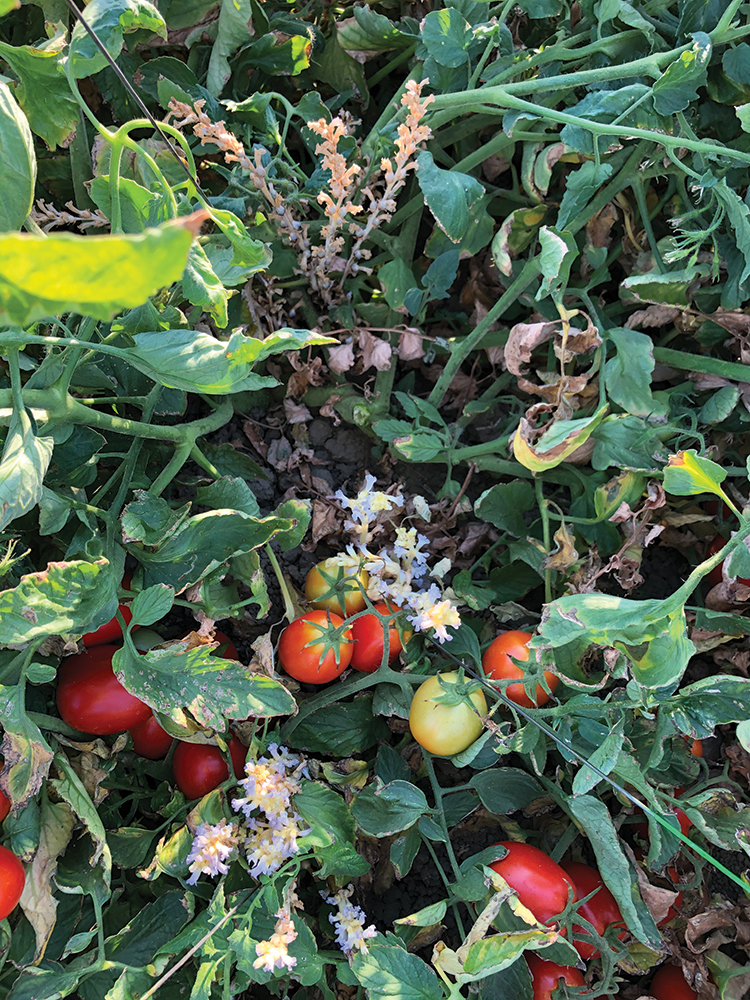
In processing tomatoes, branched
broomrape is currently a huge weed of concern.
Branched broomrape management remains UC Davis’ top priority for tomato growers, but the lessons extend to weed control across specialty crops. Hanson stressed that no one-size-fits-all solution exists. Instead, growers must know their weeds, select the best tools, set realistic control goals, and weigh trade-offs in cost, time and quality.
“It’s just a part of the landscape that we’ve got to manage weeds,” Hanson said.
— Doug Ohlemeier, Assistant Editor