

AI takes root: What’s the deal with decision support tools for specialty crop farmers?
A look at Gen AI platforms reveals promise and limitations. Explore where AI can support you — and where expert insight still matters most.





(Editor’s Note: This is the first in a three-part series looking at the use of Artificial Intelligence in the world of specialty crop agriculture. In today’s article, we discuss Penn State University Extension research on Large Language Models [aka Generative AI].)
Yes, it ubiquitously lives on our personal mobile devices, in our connected vehicles and even within our home automation and security systems, but Artificial Intelligence (AI) is also heavily deployed across many commercial fruit orchards and vegetable farms.
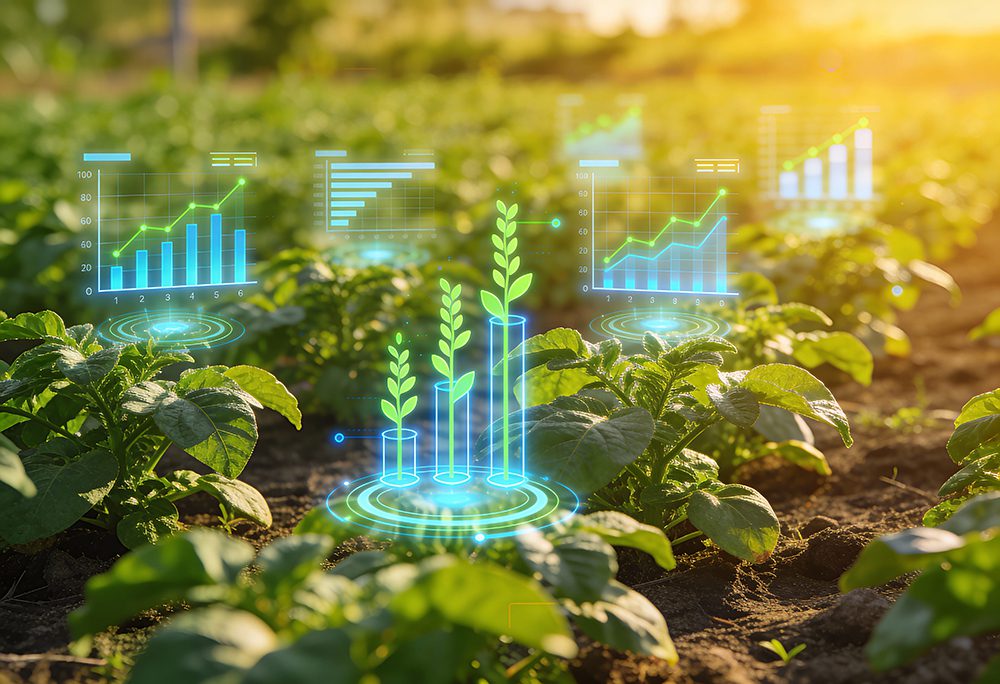
From computer vision systems that use cameras and sensors to spot disease or insect problems that evade the human eye to data platforms that take real-time, field-level data sets and crunch them into actionable insights to fine-tune irrigation, fertility decisions and harvest timing, the technology is helping growers see more, make agronomic decisions with greater confidence and automate many in-field, labor-intensive tasks.
The result is (hopefully) more efficient crop production, meaning inputs are applied exactly where and when needed, threats to yield and quality are managed earlier and important grower management decisions are driven by data rather than solely based on farmer intuition.
Let’s explore where AI is making its mark within the major Large Language Models (LLMs) that developers say can help growers make better crop management decisions.
The question: can general LLMs compete with crop specific platforms?
Artificial intelligence may feel like a very recent technological breakthrough, but a pair of Penn State Extension researchers say its origins actually stretch back decades.
Penn State University Extension researchers Leah Fronk and Jim Ladlee say early iterations of LLMs came online in the 1970s and gave rise to many of the LLMs we see know and love (or hate) today like ChatGPT, Google Gemini and Microsoft Copilot. Following ChatGPT’s launch in 2022, adoption accelerated and now you have tens of thousands of companies working in AI, with farming being no exception.
For specialty crop growers, the question is less about whether AI is coming to their farm and whether or not it will have an impact, but rather how to use it most effectively. Fronk and Ladlee undertook a research project to help farmers figure that exact question out.
Considering it represents the most accessible and common application of AI today, the research duo evaluated the major consumer LLM platforms, both paid and free versions, to gain a better understanding for how useful the question answering platforms are when used by a specialty crop farmer.
What were the results?
The pair found that overall, the LLMs excel at answering common questions and summarizing large amounts of information, but LLMs do not understand the complexities of most commercial agronomic systems.
Not yet, anyways…because that’s the thing about AI: the more data that gets fed into it (i.e. the more we use it), the better (and more accurate) it should become.
In testing multiple LLMs on a standard set of greenhouse cucumber production questions, overall response accuracy was all over the map:
- The paid AI tools such as Grok3 and the premium version of ChatGPT generally outperformed the majority of the free versions
- The unpaid versions of Copilot and ChatGPT ranked lower in how accurate they answered Fronk’s standard set of agronomic questions.
- Even the best-performing models – which surprisingly included the free version of Google Gemini – showed what Fronk and Ladlee described as “significant limitations” in providing accurate agronomic advice, the researchers found.
For growers, Fronk and Ladlee agree the most practical and useful applications of LLMs today are use cases like uploading photos of infected plants or foliage for disease and pest identification, local weather pattern interpretation and general crop management guidance.
According to the researchers, the tools are not yet reliable enough to completely trust for complex decisions like pesticide selection and application rates, farm worker safety compliance checks or detailed financial planning.
Where can I find trusted LLMs for farming?
There are several Extension published LLM platforms that exclusively pull information from trusted sources of sound agronomic information, including:
- Penn State Extension’s AI Assistant, Tilva, answers questions using educator-approved, research-based content and localizes its responses by incorporating weather and soil data based on a user’s location. Give it a try if you’re farming specialty crops in the Mid-Atlantic region at https://ai.extension.psu.edu/
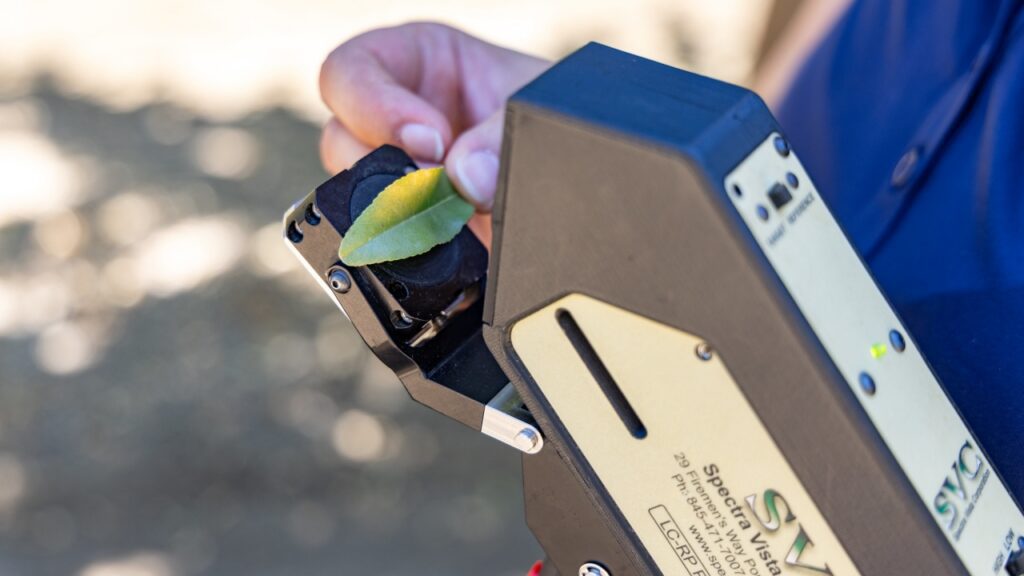
- University of California-Davis launched Leaf Monitor last fall. It’s a mobile tool paired with a handheld spectrometer backed by AI that helps wine grape farmers monitor and manage crop fertility decisions by providing real-time nutrition data. Learn more at https://engineering.ucdavis.edu/news/ai-powered-leaf-monitor-app
- For growers in the Midwest, the University of Illinois’ CropWizard 1.5 platform analyzes over 650,000 documents — including Extension publications and research papers — to provide trusted advice and analyze photos for crop stress or pests. Try it at https://uiuc.chat/cropwizard-1.5/chat
Key takeaway: LLMs can be a compliment to Extension resources and research-based recommendations, but they are not a equal substitute. Used thoughtfully — with strong, thoughtful prompts and some healthy skepticism — AI can help support specialty crop growers. But human expertise — aka dirty boots — remains a critical piece of the puzzle.
Looking for more on AI in farming? Check out this video report from The Washington Post. (Editor’s Note: Monarch Tractor recently laid off nearly its entire staff. The company is shuttering its electric autonomous tractor manufacturing and distribution segments and pivoting to software development)