







Jan 5, 2026Rolling out a new way to water: Sumisansui irrigation system
A new kind of irrigation is finding its way onto vegetable farms, and it looks a lot like drip tape — until you turn it on. The Sumisansui system, made by the Japanese company Sumika Agro-Tech, comes in rolls of flat plastic tubing with precision perforations. When pressurized, the tube inflates and sprays a fine mist into a rectangular pattern along its length.
When the water shuts off, it deflates flat again, ready to roll up and move to another field or block. That portability and boxy coverage have made it a growing curiosity among vegetable growers looking for a middle ground between drip and traditional overhead irrigation.
Where it fits on the farm
Growers have long relied on drip tape to germinate seeded crops, but fully wetting a bed top often means laying three or four lines per bed. That’s a lot of setup and retrieval for short-cycle crops like lettuce. Overhead systems — whether Wobblers on poly lines and risers, aluminum solid-set or traveling guns — handle that more easily, but they bring their own headaches: high cost, design complexity and lots of pipe and risers to work around.
The Sumisansui tubes aim to combine the best of both. They deliver water evenly in a long strip instead
of a circle, reducing the overlap calculations and nozzle spacing that overhead systems require. When the tubes are empty, they lie flat on the ground, leaving room for tractors, sprayers and some types of weeders to pass over without obstruction.
Coverage and cost
Different versions of the system fit different scales. The smaller Mark-II and R-Wide tubes can water about three to five standard beds, while the larger SumiRain covers roughly 50 feet to either side — though the most even coverage is closer to 35 to 40 feet. That’s still a broad reach compared to drip tape, especially for germination or cooling tender crops.
From a cost standpoint, Sumisansui systems sit comfortably below high-pressure sprinklers and traveling guns. Coverage works out to roughly $0.09 to $0.13 per square foot, compared with about $0.08 for the Neversink Aquifer, or $0.29 for the smallest traveling-gun systems. The tubes themselves can last up to five years before the perforations stretch or clog, and they’re simple to connect to timers or solenoids for automation.

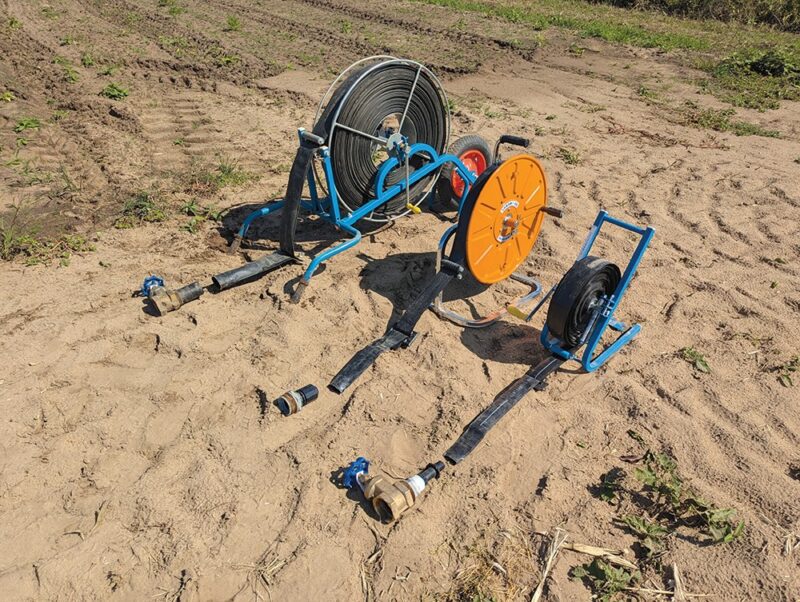
The tubes in action from left to right: SumiRain, R-Wide and Mark-II. Photo courtesy Ben Phillips.
Putting it to the test
Field trials this summer tested three Sumisansui systems under realistic field conditions, with light winds and open air — a contrast to the company’s greenhouse test data. Using rain gauges placed across the wetted zone, the systems were run at different pressures for repeated 15-minute sets.
Measured outputs averaged 0.27 to 0.32 inches of water per hour, depending on the model and pressure. In all cases, the actual effective width in the field was narrower than the manufacturer’s greenhouse numbers but still very usable.
Interestingly, higher pressure didn’t always translate into a wider pattern. The Mark-II handled 15 psi just fine (even though it’s rated for 12), but the spray width didn’t increase. The larger SumiRain showed similar behavior between 30 and 35 psi. So, while pressure influences flow, it doesn’t always expand the footprint.
Practical challenges
As promising as the system is, it isn’t without quirks. The two biggest challenges are wind and camber — the tendency of the inflated tube to tilt slightly and throw more water to one side.
The smaller systems produce a mist that can drift several feet in just a light wind. At 8 to 12 mph, the entire pattern can shift 10 to 15 feet. The heavier SumiRain model is more stable and even benefits from a little breeze to blend the pattern, but high gusts can still unspool it or tip the winder over. Irrigating in the morning gives foliage time to dry during the day for disease management; however, it is also usually less windy at that time of day, and you can get a better pattern by irrigating then.
Camber issues occur when the tube inflates unevenly on a slope or soft surface. The wind can also
displace the tubes when they are deflated. That tilt can cause puddling or dry streaks. Keeping the line taut and level, laying them in wheel tracks or stapling them down helps minimize this effect.
Crop height and maintenance
Because these lines sit on the ground, nearby weeds or crop foliage can block the spray once plants reach about four inches tall. The R-Wide model can be lifted a few inches on proprietary stakes fitted to ¾-inch pipe risers to extend its useful period in the field. For bed systems with frequent cultivation or equipment traffic, it requires planning where and how to elevate them.
Like any irrigation line, flushing is essential. Sediment or additives can clog the emitter holes over time. You can cut the lines open for flushing, though that reduces portability. The company supplies small inline filter bags for each connection — worth using, even if you filter before the header — to protect the system and extend its lifespan.
Take-home message
For vegetable farms juggling both drip and overhead irrigation, the Sumisansui system offers a flexible, lower-cost middle option. It doesn’t replace traveling guns or solid-set systems for large acreage, but it fills an important niche for smaller plantings, short rotations and quick crop changes.
In calm conditions, it performs impressively — wetting wide rectangles evenly and rolling up neatly for moving or storing. In wind or uneven terrain, you’ll need a few tricks to keep it steady. But with its blend of portability, low pressure needs and broad coverage, it’s an innovation worth a closer look.
Quick tips for using Sumisansui irrigation
Best uses
- Germinating direct-seeded crops like carrots, lettuce or spinach
- Cooling leafy greens before harvest
- Flushing weeds or incorporating fertilizers and herbicides
- Providing short-term irrigation for fast crop rotations
Advantages
- Lays flat for tractor clearance
- Roll-up portability saves setup time between plots
- Mark-II works at similar pressures to drip systems
- Lower cost per square foot than traveling guns
- Compatible with solenoids and timers for automation
Cautions
- Light wind (4 to 7 mph) can shift spray patterns several feet
- Uneven ground may cause tubes to tilt and puddle water
- Vegetation can block spray without modification
- Lines need occasional flushing and should be filtered
- Lifespan around five years before emitter wear or clogging
Pro tips
- Keep the tubes stretched tight and, if possible, run them in wheel tracks to reduce twisting and wind lift.
- A calm morning or evening is the best time to run the system.
Top photo: The tubes, winders and connectors from left to right: SumiRain, R-Wide and Mark-II. Photo courtesy Ben Phillips.
— Based out of the Southwest Michigan Research and Extension Center, Ben Phillips serves commercial field and greenhouse vegetable growers who target the fresh, wholesale and processing markets in southwest Michigan. His duties include crop scouting, pest identification, crop management and food safety consultation, resource development, educational programming, vegetable production research, and facilitating research projects with MSU’s faculty researchers and grower collaborators.